Alfred Russel Wallace
The man who, at the same time as Darwin, discovered the mechanism that explains the evolution of life on Earth.
Who was Wallace
The naturalist who
changed the history
of modern science
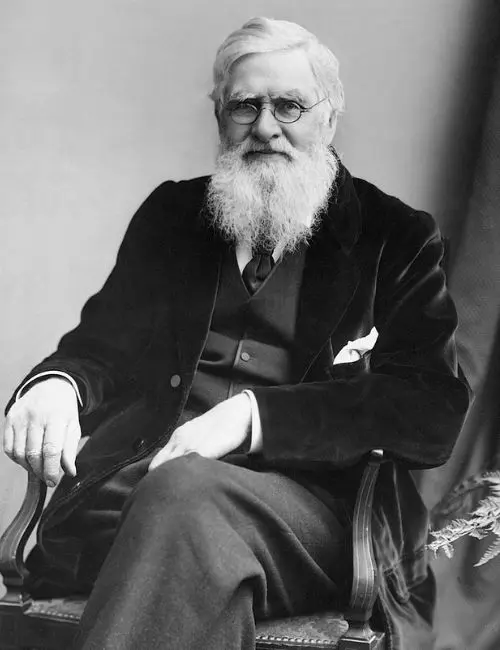
Alfred Russel Wallace (1823–1913) was one of the great scientists of the 19th century. A Welsh naturalist, explorer, and geographer, he dedicated his life to traveling to the most remote places on the planet in search of answers regarding the origin and distribution of species.
Of humble origins—born in Usk, Wales, into a family of limited means—, Wallace was self-taught in his scientific education. Without access to a formal university education, he became one of the most brilliant and prolific naturalists of his time.
His major contribution to science came in 1858 when, while ill with malaria on an island in the Malay Archipelago, he independently formulated the theory of natural selection as a mechanism of evolution—the very same idea Charles Darwin had been working on for over twenty years. Today, Wallace is recognized as one of the fathers of the theory of evolution and a fundamental figure for understanding biodiversity and the history of life on Earth.
The Great Expeditions
Two journeys that
changed science
 1848 – 1852
Expedition to the Amazon and Rio Negro
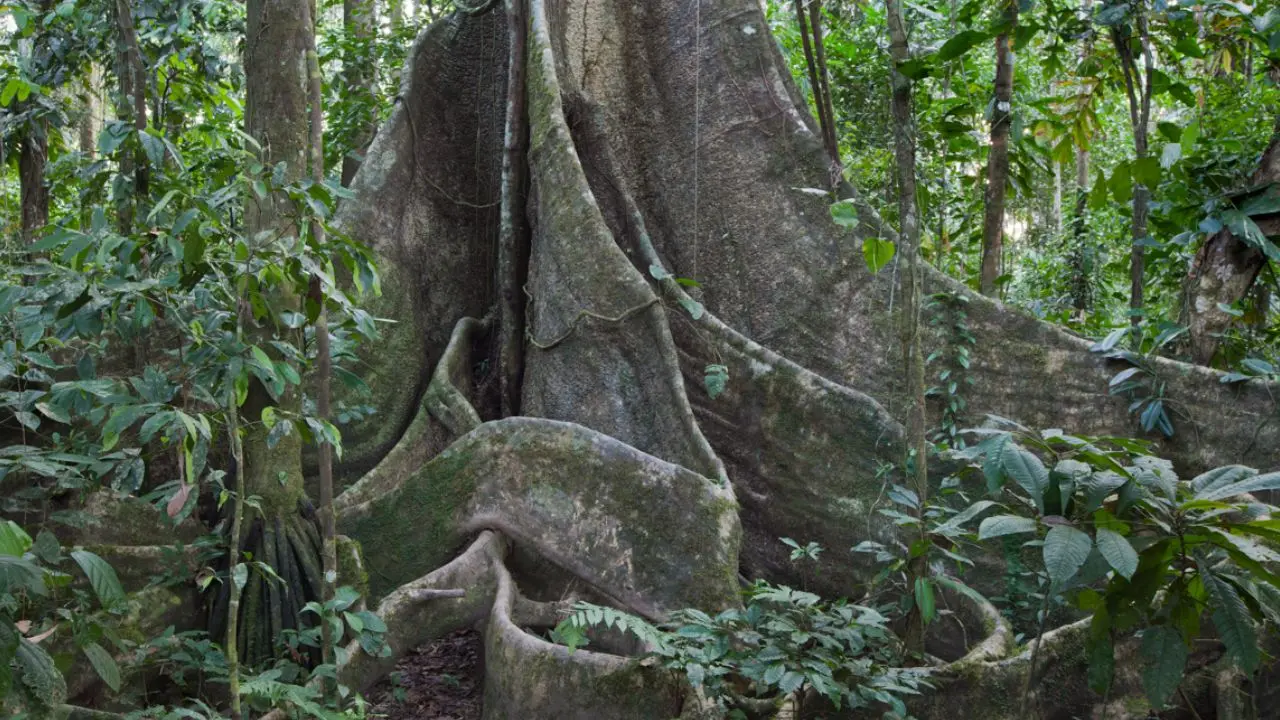
Between 1848 and 1852, Alfred Russel Wallace traversed the jungles of the Amazon and the Rio Negro, accompanied by the naturalist Henry Walter Bates. Over the course of four years, they explored territories scarcely known to European science and collected thousands of specimens of plants, insects, birds, and other animals—many of them previously unknown to the science of the time.
Upon returning to England in 1852, the ship on which Wallace was traveling caught fire in the middle of the Atlantic. Much of his collection, field notes, and drawings was lost forever. Despite this severe setback, Wallace did not abandon his scientific calling and a few years later, he would embark on a new expedition to the Malay Archipelago, where he would make the discoveries that would establish him as a key figure in the history of science.
 1854 – 1862
Expedition to the Malay Archipelago
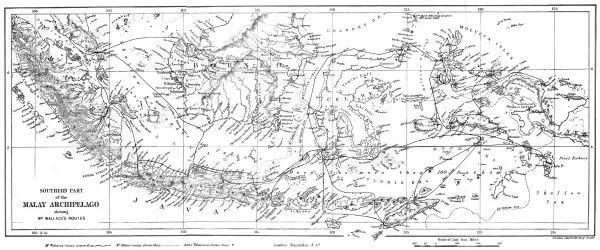
The great expedition of his life. Over the course of eight years, he traveled across hundreds of localities and numerous islands in present-day Indonesia, Malaysia, and Papua New Guinea. He collected 125,660 specimens and contributed to the description of hundreds of species new to science.
It was during this expedition that he formulated the theory of natural selection as a mechanism of evolution and identified the famous Wallace Line, a biogeographic border separating the faunas of Asia and Australasia.
The Wallace Line
An invisible
boundary in nature
One of Wallace's most important discoveries was the imaginary line that bears his name. This biogeographical boundary separates the fauna of Southeast Asia from that of the Australian region, reflecting millions of years of evolutionary isolation.
To the east of the Wallace Line, we find marsupials, birds of paradise, and unique Australasian species. To the west lies the typical fauna of Asia—tigers, orangutans, and rhinoceroses. Between the two regions, certain islands serve as fascinating transition zones.
This discovery helped establish modern biogeography as a scientific discipline.
His legacy
Beyond evolution
Wallace was much more than the co-discoverer of natural selection. His thought encompassed fields as diverse as social justice, feminism, and environmental conservation.
Father of biogeography
The Wallace Line and his work on the geographical distribution of animals established biogeography as a modern scientific discipline. His work remains a fundamental reference.
Precursor of nature conservation
Wallace was one of the first scientists to warn about the destruction of tropical ecosystems and the extinction of species caused by human activity. A visionary a century ahead of his time.
Social Thinker
A proponent of socialism, women's suffrage, and agrarian reform, Wallace believed that science should serve social justice and the well-being of all humanity.
Lugo · MIHL · 2026
Discover Wallace's life in our exhibition
The exhibition "Wallace and the Origin of Species" showcases in detail the life, travels, and scientific legacy of this extraordinary naturalist. Free admission.